Introduction
‘The power of the pen is greater than that of the sword’ a common expression to illustrate how writing can be used as a weapon for inspiring people, to communicate and engage with them and eventually win them over. Philosophers like Bertrand Russell wrote on ‘Power’ and biographers portray the lives of leaders and friends in books so that their lives will remain in words forever. We would not have heard about the humanitarian Albert Schweitzer if not for biographers and historians. ‘All men are brothers’ spells out the humanism in him and the sacrifices he and his wife made beyond colour and creed..
Art has always been a means to express oneself. Political leaders like Winston Churchill and Adolf Hitler were known to paint art pieces apart from being politicians. They were orators and also keen writers. When I was 'googling' for Ten Great Artists of the world, Western painters like Leonardo da Vinci and Michelangelo appeared. A common theme in all these painters is the impact Christianity had on their works.
Caravaggio (1571-1610) used the candle or light in his paintings often closely adhering to realism. Even details of ‘dirty feet’ were included. The inclusion of male figures (Calling of Mathew) is an illustration of religiosity that appealed to the people then. But each artist had his style. Caravaggio’s works were said to be ‘quirky’ with his subjects being ‘androgynous and erotic’.
Titian (1480s) often showed his strength in his paintings with strong colour. One great work of his ‘Venus of Urbino’ coveys ‘delight in erotic pleasure, often deriving his inspiration from mythological characters. There often appears an intertwining of myths, religion and illusion in many paintings of that period.
Ruben (1577-1640) dramatised the events using figures which were complex and caught between ‘heaven and earth’. ‘The Descent from the Cross’ clearly draws his imagination from religious teachings.
Sketching is a form of art and I have often tried to keep boredom away by sketching. At times there is no firm plan in such activities and it all depends on the moment, hence , any space on the pages (hard copies) of the minutes of meetings are not spared. Sketch on them, was my philosphy. Many call this ‘doodling’.
Is it Art of Doodling?
The following sketches have no themes, but are just free drawing on whatever came to my mind. People seated next to me were often the inspiration to practice drawing profiles. I wanted the face profiles to be facing left (as most times I found it easier to keep the faces the right!). There you have (left ), all the profiles facing left!
 |
| Kept the left hand hidden |
 |
| Profiling to the Left |
As you keep going on this hobby . At other times, many thoughts come to my mind and all the elements that I did not know about the great painters appear to become operational. There is a great deal of dynamism in the process. For instance, I always felt it was very difficult to place more than two figures together as I could not get the proportions correct. Should I try and get over that, hence the following was drawn (at home, drawn from some newspaper articles).

Well, then I thought that it is worth including some thoughts people express in the illustrations (Idea from Mera Pind), ‘can we have culture ,when things go away, we can create a little space for ideals and ideas!.
After that came a series of fervent attempts to do some profiling and including words of ‘wisdom’ lest they be lost forever appeared .
Recalling History

I was not sure if the three illustrations above are recognizable as our forefathers of Malaysia. A young colleague working in the computer division in my university could recognise them as our former Prime Ministers but she could not name them (the generation gap). Tengku Abdul Rahman, Tun Abdul Razak and Tun Hussein Onn did not evoke that much controversy (at least that I can remember) as I was growing up. But I can now see how geopolitical changes have rapidly enveloped us in more negativism than positives. All three PMs had to contend with communism as a threat and the community leaders were relevant in putting this country together to live harmoniously although there were firebrands in the Parliament then in people like Tan Chee Koon, the Seenevasagam brothers (from Ipoh), Lee Kuan Yew (when Singapore was part of Malaysia).
Well Known Artists and Pretenders
Picasso (1881-1973) was said to have produced some of the best works when he was younger but his style, when he started to promote CUBISM gave meaning to new perspectives in art. When he drew ‘Guernice” there was distortion and torture with decomposition and lack of form in humans and animals. I thought this was an exercise in non-conformism. It releases the artist from insisting on realism and character, perhaps it is an illustration of boredom or arrogance in art.
I was scanning a Sunday magazine two years ago in Edinburgh when a thought came to me that I should try to draw some of the illustrations in that magazine. But I had forgotten to bring along my paper and pencil. I expressed my frustration to my daughter who did not tell me she had slipped out to the nearby shops to get just those paraphernalia (at a cost of 7 sterling pounds!).
Not to disappoint her I sat down to try to draw the following but Picasso’s original were too painstaking to detail that I added my own to complete the task.


Vincent von Gorg (1881-1890) was a Dutch painter who led a depressed life not being able to sell his paintings as they did not fall in line with the themes of that era. His brother was his agent. His religious background and his own personality contributed to his lack of purpose in his life. He drifted from place to place drawing on his inspirations from the common folks and life in the village. Many of his drawings and paintings were dull and depressing until he experimented with brightness and colour though they had a naivety in them. As I was glancing through a book of his paintings I thought I could sketch to determine if an onlooker could recognise them without knowing they were drawn from von Gorg’s work.

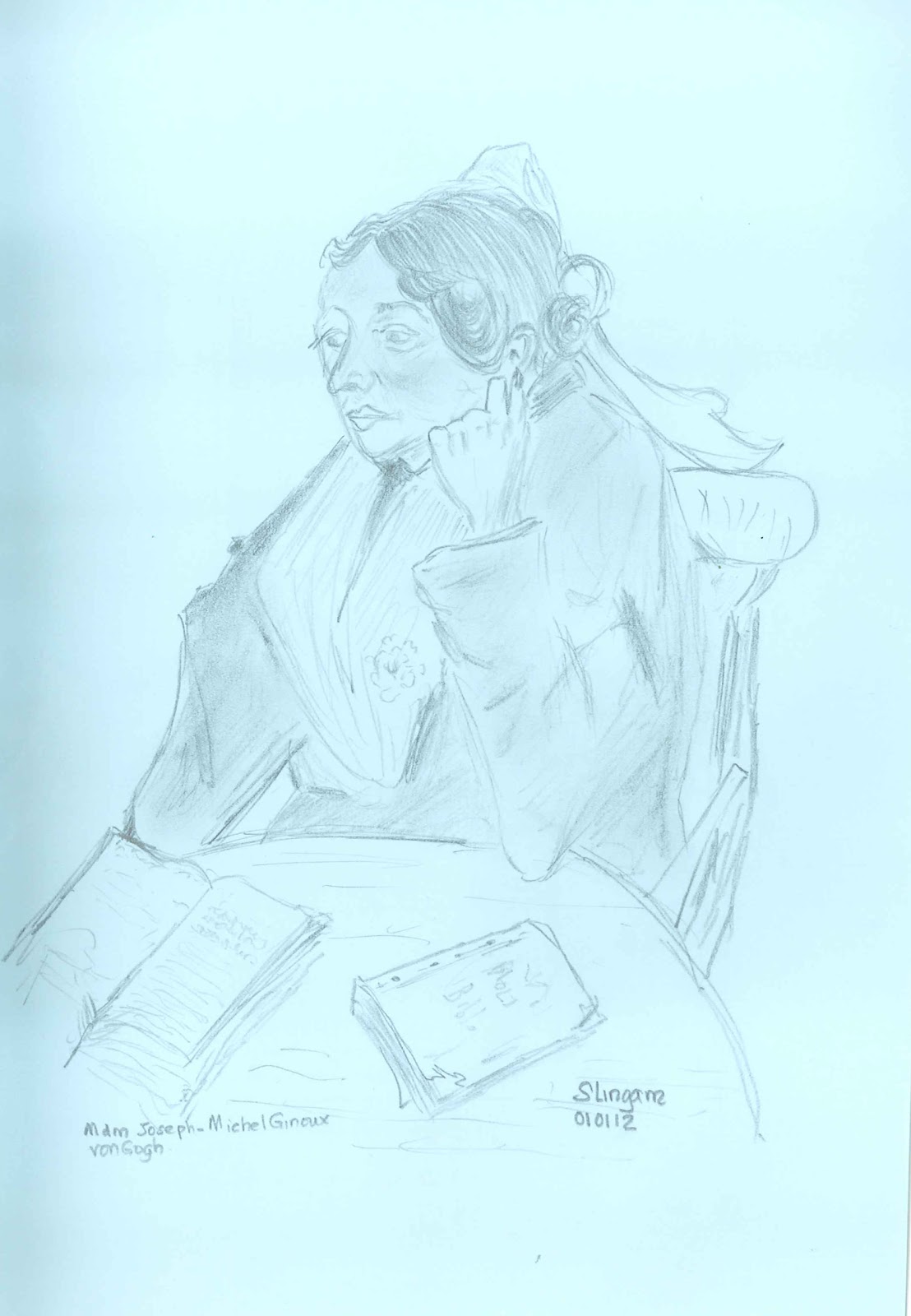


I found it difficult to put his paintings (in colour) on paper using a pencil. The fields in front and the dull overcast and depressed winter do not come out well.

This illustration of ‘another depression’ of von Gorg was an attempt to try to get the proportions correct. I often had a problem drawing the hands and the feet and hence I have pushed myself at various attempts to get this aspect correct, most times, it fails, as is shown below.
Get at the difficult task
The teenager hugher up had both her hands out but it became too frustrating to get the fingers of her left hand, so I conveniently parked it behind her!
As I tried to launch myself to more sketches, I also thought some words would add to the meaning of the sketch, hence started to pen some of my thoughts in the process.

‘The feet were not getting out of me’, I thought, and hence sat down to draw just that, without losing myself in the rest of the body and environment. Keeping the tress empty was most apt as it cut down my duration to complete the picture and by making the tree ‘shed its leaves’!
Von Gorg is said to evoke emotional and intellectual resonance, but the poor artist would not have committed suicide if due recognition was given early in his life and he had the drugs and treatment we have today. While the 1400s drew their inspiration from Christian theology many of the Asian artists played to the political events of the day, the success work of others who appealed to collectors and impression lists.
Conclusion
Art in the form of paintings, sculptures and handiwork will be part of the human culture. They evoke meaning to life and have been affected by moments of the day. It was not easy for Claude Monet to get his ‘Impressionist School’ in Givery as heintroduced realism in art. It looks so simple; give life to the flowers and the house and the village by way of painting. Art appears to be an experiment on paperand canvas , based on the working of the mind. Some may be symbolic while others have hidden expressions that need Freudian analysis. Just try reading my mind when I drew the following!


Sivalingam
2 Feb 2012

