Thursday, 2 February 2012

Free Expression in the world of Art

Introduction
‘The power of the pen is greater than that of the sword’ a common expression to illustrate how writing can be used as a weapon for inspiring people,  to communicate and engage with them and eventually win them over. Philosophers like Bertrand Russell wrote on ‘Power’ and biographers portray the lives of leaders and friends in books so that their lives will remain in words forever. We would not have heard about the humanitarian  Albert Schweitzer if not for biographers and historians. ‘All men are brothers’ spells out the humanism in him and the sacrifices he and his wife made beyond colour and creed..
Art has always been a means to express oneself. Political leaders like Winston Churchill and Adolf Hitler were known to paint art pieces apart from being politicians. They were orators and also keen writers. When I was 'googling' for Ten Great Artists of the world, Western painters like Leonardo da Vinci and Michelangelo appeared. A common theme in all these painters is the impact Christianity had on their works.
Caravaggio (1571-1610) used the candle or light in his paintings often closely adhering to realism. Even details of ‘dirty feet’ were  included.  The inclusion of male figures (Calling of Mathew) is an illustration of religiosity that appealed to the people then. But each artist had his style. Caravaggio’s works were said to be ‘quirky’ with his subjects being ‘androgynous and erotic’.
Titian (1480s) often showed his strength in his paintings with  strong colour. One great work of his ‘Venus of Urbino’ coveys ‘delight in erotic pleasure, often deriving his inspiration from mythological characters. There often appears an intertwining of myths, religion and illusion in many paintings of that period.
Ruben (1577-1640) dramatised the events using figures which were complex and caught between ‘heaven and earth’. ‘The Descent from the Cross’ clearly draws his imagination from religious teachings.
Sketching is a form of art and I have often tried to keep boredom away by sketching. At times there is no firm plan in such activities and it all depends on the moment, hence , any space on the pages (hard copies) of the minutes of meetings are not spared. Sketch on them, was my philosphy. Many call this ‘doodling’.
Is it Art of Doodling?
The following sketches have no themes, but are just free drawing on whatever came  to my mind. People seated next to me  were often the inspiration to practice drawing profiles. I wanted the face profiles to be facing left (as most times I found it easier to keep the faces the right!). There you have (left ), all the profiles facing left!


Kept the left hand hidden
Profiling to the Left


As you keep going on this hobby . At  other  times, many  thoughts come to my mind and all the elements that I did not know about the great painters appear to become operational. There is a great deal of dynamism in the process. For instance,  I always felt it was very difficult to place more than two figures together as I could not get the proportions correct. Should I try and get over that, hence the following was drawn (at home, drawn from  some newspaper articles).

Well, then I thought that it is worth including some thoughts people express in the illustrations (Idea from Mera Pind), ‘can we have culture ,when things go away, we can create a little space for ideals and ideas!.
After that came a series of fervent attempts to do some profiling and including words of ‘wisdom’ lest they be lost forever appeared .
Recalling History
I was not sure if the three illustrations above are recognizable as our forefathers of Malaysia. A young colleague working in the computer division in my university could recognise them as our former Prime Ministers but she could not name them (the generation gap). Tengku Abdul Rahman, Tun Abdul Razak and Tun Hussein Onn did not evoke that much controversy (at least that I can remember) as I was growing up. But I can now see how geopolitical changes have rapidly enveloped us in more negativism than positives. All three PMs had to contend with communism as a threat and the community leaders were relevant in putting this country together to live harmoniously although there were firebrands in the Parliament then in people like Tan Chee Koon, the Seenevasagam brothers (from Ipoh), Lee Kuan Yew (when Singapore was part of Malaysia).
Well Known Artists and Pretenders
Picasso (1881-1973) was said to have produced some of the best works when he was younger but his style, when he started to promote CUBISM gave meaning to new perspectives in art. When he drew ‘Guernice” there was distortion and torture with decomposition and lack of form in humans and animals. I thought this was an exercise in non-conformism. It releases the artist from insisting on realism and character, perhaps it is an illustration of boredom or arrogance in art.
I was scanning a Sunday magazine two years ago in Edinburgh when a thought came to me that I should try to draw some of the illustrations in that magazine. But I had forgotten to bring along my paper and pencil. I expressed my frustration to my daughter who did not tell me she had slipped out to the nearby shops to get just those paraphernalia (at a cost of 7 sterling pounds!).
Not to disappoint her I sat down to try to draw the following but Picasso’s original were too painstaking to detail that I added my own to complete the task.


Vincent von Gorg (1881-1890) was a Dutch painter who led a depressed life not being able to sell his paintings as they did not fall in line with the themes of that era. His brother was his agent. His religious background and his own personality contributed to his lack of purpose in his life. He drifted from place to place drawing on his inspirations from the common folks and life in the village. Many of his drawings and paintings were dull and depressing until he experimented with brightness and colour though they had a naivety in them. As I was glancing through a book of his paintings I thought I could sketch to determine if an onlooker could recognise them without knowing they were drawn from von Gorg’s work.

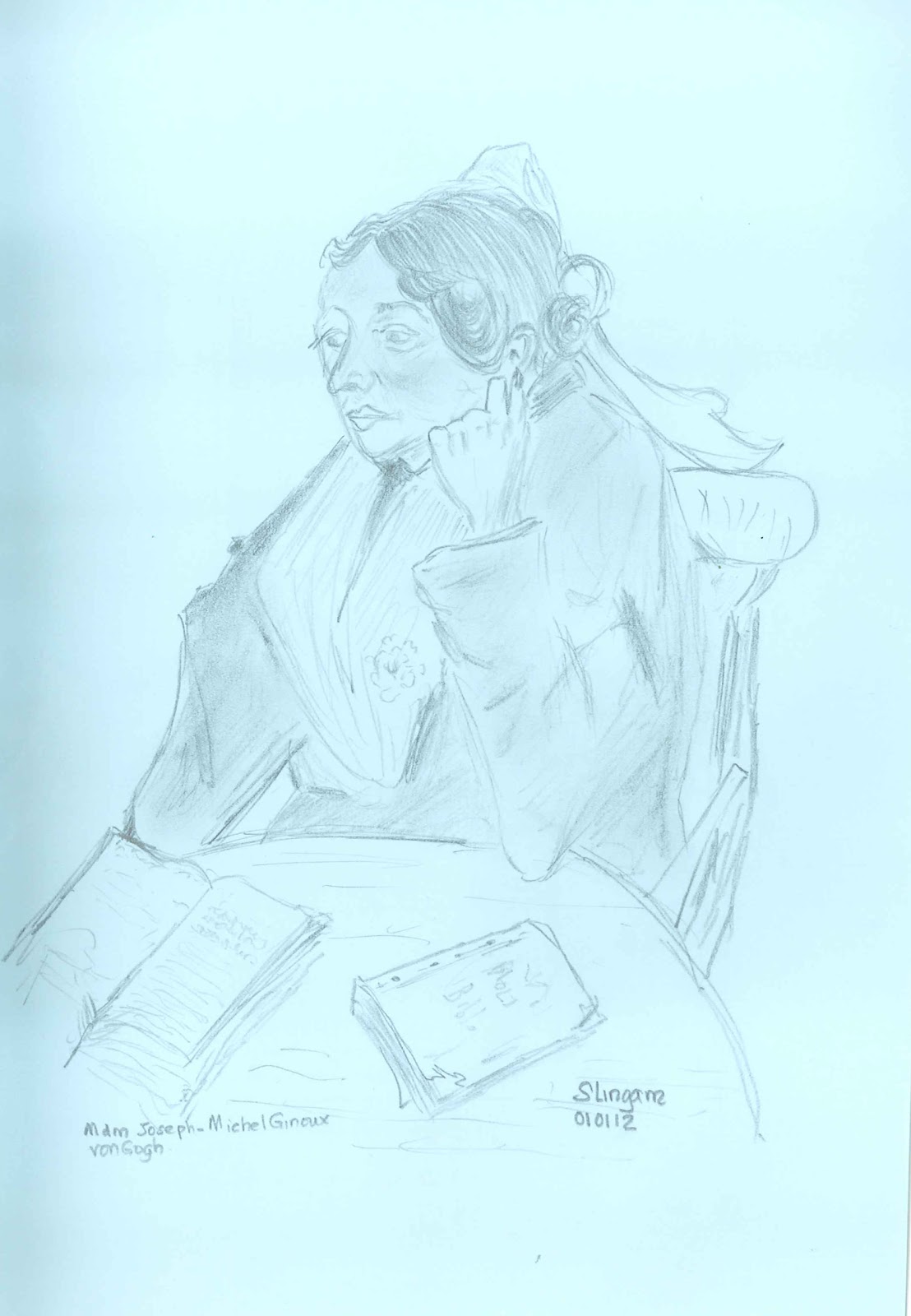

I found it difficult to put his paintings (in colour) on paper using a pencil. The fields in front and the dull overcast and depressed winter do not come out well.
This illustration of ‘another depression’ of von Gorg was an attempt to try to get the proportions correct. I often had a problem drawing the hands and the feet and hence I have pushed myself at various attempts to get this aspect correct, most times, it fails, as is shown below.

Get at the difficult task
The teenager hugher up  had both her hands out but it became too frustrating to get the fingers of her left hand, so I conveniently parked it behind her!
As I tried to launch myself to more sketches, I also thought some words would add to the meaning of the sketch, hence started to pen some of my thoughts in the process.


‘The feet were not getting out of me’, I thought, and hence sat down to draw just that, without losing myself in the rest of the body and environment. Keeping the tress empty was most apt as it cut down my duration to complete the picture and by making the tree ‘shed its leaves’!
Von Gorg is said to evoke emotional and intellectual resonance, but the poor artist would not have committed suicide if due recognition was given early in his life  and he had the drugs and treatment we have today. While the 1400s drew their inspiration from Christian theology many of the Asian artists played to the political events of the day, the success work of others who appealed to collectors and impression lists.
Conclusion
Art in the form of paintings, sculptures and handiwork will be part of the human culture. They evoke meaning to life and have been affected by moments of the day. It was not easy for Claude Monet to get his ‘Impressionist School’ in Givery as heintroduced realism in art. It looks so simple; give life to the flowers and the house and the village by way of painting. Art appears to be an experiment on paperand canvas , based on the working of the mind. Some may be symbolic while others have hidden expressions that need Freudian analysis. Just try reading my mind when I drew the following!


Sivalingam
2 Feb 2012
 

Sunday, 15 January 2012

Resolutions for the NEW YEAR

New Year Resolutions repeatedly appear before the  close of the year and continue to be published year in year out in media. I tend to be envious of the opportunities granted to the few invited columnists who tend to share their thoughts with readers. Many now see these comments has parochial, redundant and with little effect on the lives of many. Two articles appear in the NST ( Jan 14, 2012) and are  worthy of comment.
Haris Hussein eloquently traces his thoughts back to his youth and resents making resolutions as they get broken within ‘15 seconds of being made’. Emma Reynolds, yet another columnist extends the period of breaking their New Year resolutions ‘nine days after they are made’. She goes on to explain that many resolutions are often for the betterment of physical and emotional well being.
Just as we want to be better persons and live in peace resolutions are reflective in nature and makes one realize the need to review, repent and pave the way to better living. But is it appropriate to make resolutions based on one  calendar year? Perhaps we need to look long term as behavioral changes do not occur overnight!

Even if one believes that resolutions are integral to life, it appears  futile that in our  earnest desire to set new goals to improve ourselves and the lives of others, we don’t sustain them, as commented by both the above columnists. It is then fundmanetal that we set should goals for life rather than for each calendar year. There needs to be a purpose in life and setting goals paves the path to a direction.
Some of us resort to mentors, gurus and teachers who would facilitate achieving the goals we set. Motivational speakers are  aplenty and continue to attract huge audiences wanting to listen to their clouded comments and pragmatic solutions using analogies that appeal to logic. They captivate many. However, how much they impact on the lives varies a great deal. When the discourse invites a fee, often I fail to see the honest intention!
Exposure to the media permits us a window to the world. Newspapers tend to sensationalise the plight of a few and report events that often relate to catastrophes and bad intentions of humans. The message is clear that many humans are in need of food, money, education and medications. Transport and poor infrastructure and illiteracy are the cause of lack of access for healthcare and education.  Lack of political committment and abuse of power by leaders for personal gain contributes to the plight of the world’s citizens. The few NGOs and well wishers continue to uphold that principle of sharing and wanting to give to those in plight.
Many want to give but can’t or don’t know how to. ‘Teach them how to fish, don’t give them fish’ a common saying that promotes the idea of facilitating the under privileged to learn new methods to fend for themselves is such a noble notion. Could we organise a voluntary group to salvage the old bicycles and furniture that many discard , to be repaired and refurbished, to be sent to those in need. Several projects of this nature have contributed to the improvement of many who find transport and access to schools near to be impossible.
Deepak Chopra, a well known inspirational and motivational speaker and author of numerous books on similar topics prides in his interpretation of life and organization of the world through his views, which I think has a strong basis on the philosophy of life derived from ancient India. He speaks with little uncertainty  that the world economic crisis is due to cronyism, corruption and power mongering of the ‘bankster’, gangsters in the financial industry. A subject well articulated in the NST (Jan 14, 2012) entitled “The Soul of Consciousness’’ explores Deepak’s deep thoughts on a variety of topics relevant to the social and economic climate today. He says that it is not acceptable that 50% of the population live on less than $1/= US a day and 20%, on less than $2/= a day. There is a Jain saying that there is ‘there should be  doubt in any certainties’.

Those who mean well are not comfortable with the leaders of the world who bleed their citizens under the pretext of governing. Henry D Thoreau, the moral philosopher, said that ‘the government is best that which governs least!’ Will this argument find responsive ears? He first promoted the term ‘civil disobedience’ which became the hallmark of the black movement of US under Martin Luther King who drew meaning from a freedom fighter, Gandhi. Mahatma (the Great SOUL) Gandhi  fought for independence in India largely based on non-violence and civil disobedience. He writesthat his earliest period of his life was one of ‘storm and stress’ just like what many adolescents go through, as he was experimenting with life. When he was studying at the Inns in London he was a ‘volatary of violence’ and often repeats for  the need to practice the ‘silence of a monastery’ when there is a clash between violence and forgiveness, seeking out the latter most times. Even when one does not agree with another Gandhi professed that one should focus the anger on the ‘arrogance rather than the person’.
The world has reached the ultimate and the balance is tipping to further erosion of values and destruction of the environment.  Deepak Chopra calls for collective conversation to meet the economic disparities and gross social injustice, call off terrorism and stop the devastative acts that is destroying the eco-system.
He is averse to positive thinking, a term that often appears to melt down argument. The world class tennis player, Nadal, recently commented that being the ‘nice kid in the block’ is not the way to make change as he laments about the punishing tennis playing circuit that would lead to early self destruction because of ‘self injury’. We have to speak out; he says and cannot keep quiet when we can’t cope!
Deepak Chopra feels talking positive in the midst of all circumstances stifles creative thinking. His comments that positive thinking are worthy of repetition. Quoting J. Krishnamurthy, he says that the highest form of intelligence is the ability to observe  without judging yourself. When you are a silent witness to your own thoughts, emotions and feelings, your own behaviour and your own speech, there is a subtle but definite transformation that leads to higher consciousness. Instead of having a positive mind, how about having a quiet mind?’
The last statement clearly points to the teachings of the Bhagavad-Gita and the guidance given by the many gurus, the need to move one stratum higher in self realization. The governing principles of achieving peace and wellness now appear to transcend to personal transformation and impacting this goodness to the environment. So are the annual resolutions necessary?
Sivalingam
15th Jan 2012


Saturday, 31 December 2011

What's in your mind


A baby is born
The delightful news about the birth of our first grandson, Rahul purported my wife to add a few notes on the congratulatory card she had bought. When I protested that there were enough well written wishes in print and the fact that my wife had already crowded the side of the page  with many words of her own, she insisted I should add my own words. Reluctantly I wanted to add another congratulatory note to my son, but I thought I should a bit original. So I wrote,
“When a baby is born,
So is a mother, and a father & .....”
I submitted my share and then I learnt that what I had written was not new!
It took us over two months before we could cuddle the new addition to the family. After getting acquainted with not only the newborn  but also the new mother and father, the short spells when I was able to cuddle him evoked new feelings and experiences. Trying to exclude all medical knowledge of child development I wanted to remain a grandfather and continuously awaited the correct signals from the new ‘mother’ as the baby was being exclusively breastfed. Fearful of breaking the routines lest the infant becomes fretful, I waited my turn to retain him in my arms.
The time did come, not very long after, and there was that short communication when he maintained his focus on me feeling delicate and appearing thoroughly innocent. It was at that point that I pondered as to what was going on in his mind. The eyes were bright and there were no distractions except for the blinking of his eye lids. I could recognise at least five differing expressions on his face , other than that due to his his cry. His tongue shot out rapidly as he tried to get a taste of his clenched hand. It lasted perhaps five minutes before he got bored and started exploring around. What was clear was the maturity of the muscles of the face and the uniqueness of the mind. He would never be able to tell me what went through his mind during the five minutes and I will never know his thoughts.
The brain is an amazing organ that continues to be explored. It develops so fast and remains active for a greater part of our life. What is astounding is the difficulty we all have as to how it works to coordinate the rest of the body. We are clouded by the functionality of the brain and the exhibition of its attributes as behaviour, mind and feelings. Is the mind a separate entity? The controversy will always invite intense discussion. The working of the mind has been the subject of research contributing to the development of a new field called psychology, originating  not some 200 years ago
.
The Locked-in Syndrome
The cuddling of our new infant and the attempted exploration of his thoughts brings me to a novel I read based on a Frenchman, chief  editor of ‘Elle’ who unfortunately suffered a catastrophic stroke that affected his brain stem sending him into a coma for 20 days. Although he drew himself out of the comatose state, he was a total neurologic ‘vegetable’ requiring mechanical support and total nursing care. Jean-Dominque Bauby was totally paralysed except for his ability to see the world through the window of one eye and being able to respond by blinking.
The ‘locked in syndrome’ Bauby suffered illustrtaes  the frustrations of a 45 year old man who had been a writer all his life, wanting to portray the inner strength he has in expressing his feelings to the outside world. He articulates these feelings through Claude Mendibil who ‘painstakingly translates Bauby’s inner feelings and thoughts into works based on the flicker of his eyelids. Clearly Claude retains  an amazing understanding of his past life and his present predicament. Alive he is, but he fears the loneliness and suffers the frustrations of his invalidity. The book composed by Claude entitled ‘The Diving Bell and the Butterfly’ clearly reflects on Bauby’s isolation as if confined under an impenetrable metallic bell despite being aware there is a huge wide world out there. The brightness of the butterfly is one to be admired but as Bauby feels, while one knows about its beauty, its life is rather short.
Although Bauby did not suffer his entrapment for long (he died) the earnestness to share his feelings with care givers and others makes the book good reading. One can’t deny the compartmentalised way patients are treated nowadays and this is well portrayed in the book. He has sufficient time to reflect on the days he spent giving his aged 93 year father a shave and the unplanned trip he makes to the 'Lourdes' in Rome  with Josephine , his wife who spends a greater part of the drive to the Holy Land reading about the life of Charles Sobraj in ‘The Trail of a Snake’. He relents his poor understanding of religion when he is reluctant to wait in the half mile queue outside the Basilica when he is curtly told off by Josephine ‘it would do a sinner like you good!’ He also recollects the wink he gives a waiting invalid devotee who responds by  sticking his tongue out when he blushed ‘stupidly scarlet'.
The systematic way he dissects the nursing care he gets at the naval hospital in France is worthy of note and would be a motivating factor in teaching the novices in the medical field about empathy and holistic care. The daily daily he goes through, as if being processed like some dirty laundry, is poignantly portrayed rather melancholically. He has little embarrassment to contend with as his carers turn him on his special bed, clean everypart of his body, change his urianry catheter, transport him in wheel chair and at times ,leave him alone for hours on end permitting him to watch  TV where the channel is not changed although he prefers to watch documentaries. He describes the ugly side of an ophthalmologist who comes to stitch up his ‘lazy eye’ not realizing the benefit of it in avoiding the eye drying up and developing corneal ulcers. The fear of having the good eye (the only window to the world)  stitched up similarly   shows the lack of communication between patient and doctor.
Exuberating humour Buaby observes a demented woman who bites nurses, seizes the genital of orderlies and screams 'fire' invoking unintended fear in the ward. She is often left screaming her lungs out. He dreads Sundays when his visitors fail to arrive, no physiotherapists, no speech therapists and no psychiatrists. He feels Sundays are like crossing a desert. Even the nurses on duty are pre-occupied with their own gloom and lethargy recovering from their visits to the pubs on Saturday night. He sees how time gallops away and yet no one is around to read him the books that are aplenty in the ward.
Decision making and the Working of the Mind
The decision to treat terminal illness and those who find no quality in life is fraught with much controversy and disdain. Theologians leave the answer to divinity and the pragmatists profess assisted euthanasia as a way out. Doctors are ever in a quandary when the mechanical respirator should be disconnected. Albert Einstein was suffering from severe abdominal pain towards the end of his career when he was diagnosed with impending rupture of an abdominal aneurysm. When surgery was being contemplated he declined retorting that he has had a good life and that he be left alone with some papers and pen so that he could put his mathematical thoughts till the end. Although admitted to a hospital in Princeton he passed away on the 18 April 1955 without further intervention having completed some 10 pages of mathematcial formulae
.
The saints and sages contemplate working on the soul  to move to an ' upper level of conscious state', to Nirvana, devoid of the working of the ‘monkey mind’. Self realization is a state of mind that keeps one at peace with oneself. Again one questions what is the 'mind' and if there is an anatomical location for it. The pineal body was once thought to be the seat of the mind. Without going into any controversy I am reflecting on what my grandson was thinking as he focussed his eyes on me for that short five minutes, as the eyes were intense and deep thoughts were inevitable. Bauby was consciously expressing his feelings though trapped within his ‘mind’. He was not meditating but if he had been taught the elements of meditation he may have been able to detach him to a state of conscious that would have made his existence less painful. He may not have to bear the pain of seeing the less than empathetic treatment he alludes to. Indeed it is perplexing how the mind  works!
Sivalingam N
31 Dec 2011


Saturday, 10 December 2011

The Games We Play

The Games We Play
When I was in New York some 10 years ago my colleague asked me if I was game to go to the Letterman’s Reality Show. My first question was how much it would cost and when he replied that he could get a cheap ticket for  less than US$ 50/= , I reluctantly agreed. He had asked the Malaysian UN Representative’s office staff to assist us. The officer  whom he had approached had laughed at him as we did no know that one would have to book at least six months ahead for the show!  However, we  were pleasantly suprised at  alternative arrangements made to see the ‘Beauty and the Beast’ play which had been running for over a month.
Plays, Concerts and radio-TV shows are popular means of entertainment and they play to full audiences every night they open in the US, UK and Europe. I am reminded of U-En Ng’s comments in the NST (December, 11). He commented on the lack of enthusiasm and patronage in Malaysia when it comes to exhibitions and performing art in Malaysia as they don't run long enough for the sponsers to make enough profits. He comments on the excellent  facilities  we have in the Petronas Philharmonic Hall and the numerous cultural centres in this country. But performing art, the fine arts and exhibitions appeal to but a small segment of our society. Neighbouring Singapore has made it more attrcative or is that more Singaporeans are taken up by the these concerts and plays.
U-En Ng  laments that Bridges’ Project ‘Richard 111’ with Kevin Stacey is not playing in Malaysia  and one would have to travel to Singapore to catch it.
The Art Theatres in Malaysia are kept alive by small groups of interested actors. Tiara Jacqueline has come on bravely in making some successful shows. The Instant Cafe was a hot when it brought on the best of stand up display by a few actors like Indie Nadarajah. We do see several plays being staged though they don't run for weeks on end as in the West.  I am told that several Chinese troupes are reviving the art and we do see the occasional Taiwanese plays. Ramli Ibrahim’s Indian cultural dance shows appeal to a selected group including expatriates.
Performing Art, Literature and Language will play pivotal roles in crafting a new populace that can’t be compared to education acquired through the formal syllabus preparing one to pass an examination. The ‘cultural desert’ we survive in needs to be watered down with elements of fine arts and the wisdom imparted through literature and the human expressions seen through play acting. Learning through parables has been in vogue from time immemorial. Greek mythology and Shakespearean tragedy send home clear signals relating to ethical and moral principles of life. The Aesop’s fables taught us, as children, the social norms and morals that should be incumbent within. Religious instructions and the verses of holy books all teach us to be good and be humane through stories and verses. 
I was asked to deliver a lecture recently on ‘Pregnancy in  the Advanced Age’. I was wondering what new can I say to the audience who would be largely professionals who themselves are not new to the common problems surrounding the woman who gets pregnant late in her life (after 35 years). The oldest woman who had conceived by assisted conception ( IVF) was 70 years !  I had but 25 minutes to convey my message. After doing so research and completing my power point presentation, it dawned on me that instead to adding the last slide with a ‘Thank you’, I should pen a short poem about the ‘aging egg’. I thought I shall share this poem (if you consider it to be so) so that I can include myself as having contributed to the work of ‘ART and Living’.


The Aging Oocyte

Trapped , I was   for  43 years
In the ovaries of my Egg Bearer
I was not recruited to join the other oocytes
As I was to remain as primordial

I was told that that my colleagues, fellow oocytes
Were mature to go onto to the surface
Of the ovary , to join in the race,
To find a suitor, the ideal sperm

My Egg Bearer thought otherwise
As she postponed her reproductive function
For a career as a professional
Though she was already 30.

When she found the right guy
I was still destined to remain dormant.
Suppressed, oppressed  and depressed
Surrounded by  hormonal contraception

At 43 , I heard that My Egg Bearer was ready
To permit the ‘release’ from my confines
But then I was already old
ATP and  vigour , I had but little

My ‘egg mother’ went to an IVF centre
I was bombarded with FSH, LH and Hormones
I remained unmoved for a while
Till the fourth attempt, I got out from imprisonment!

I pulled out of my slumber
Too weak to make
The passage all the way to the ovarian surface
Of the right ovary where I had resided so long.

I made it to the site
Where I was destined to be rescued
By a directed metal  probe,
They called it 'Egg Retrieval'!

They dropped me  into a petri dish,
Surrounded me with nutrient media,
Poked my skin with a micromanipulator
Trying to get my 42 year suitor in , a sperm.

We are now in union
As an ‘embryo’ they say,
Waiting for our turn to be transferred
Again we have to wait till the other attempts in embryo transfer fail!

We hope we don’t have aneuploidy ,
Or breaks in our life string, the chromosome.
We hope we will survive the transfer
The implantation into the uterus

We promise   to behave , not produce some rejection
In our destined place , the uterine cavity,
As we are old in years; between us we are 85
Pray, don’t let this happen to others  please !

Dato Dr Sivalingam Nalliah (10 Dec 2011)
Penned for the lecture on ‘Pregnancy in the advanced age’ at the O&G Congress, College of O&G Academy of Medicine


Sivalingam Nalliah
11 Dec 2011